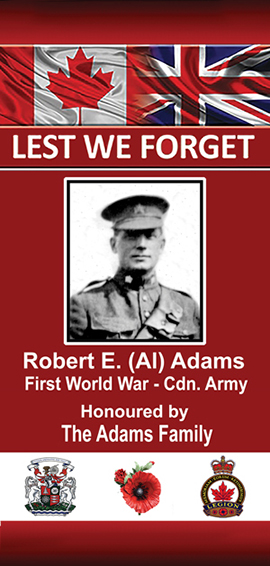
Robert Elmer Adams was born on February 18, 1885, to Thomas and Maria (nee Bullied). He was one of 14 siblings raised on a farm in Clarke Township near the Canadian Tire Motorsport Park. All the children worked alongside their parents on the farm, and attended a local one-room rural schoolhouse.
Although his given name was Robert, he went with his middle name Elmer, shortened to the nickname Al. Al and two of his brothers were part of the 1901 Champion Leskard Football (soccer) Team in the Clarke Football Association, which had 11 members. He worked on a train crew as a brakeman on the Ontario and Quebec Railway, a subsidiary of the Canadian Pacific Railway (CPR) that operated the Toronto to Peterborough line that traverses the northern boundary of Clarington.
At 30, Al volunteered to serve in the First World War on February 25, 1915, and was assigned to a Southwestern Ontario cavalry unit, the 7th Canadian Mounted Rifles. The cavalry unit mobilized in London, Ontario on March 15, 1915, for training and shipped out of Montreal for England on June 9, 1915. On arrival, they trained at the Canadian Cavalry Depot in Canterbury and later landed in France on September 17, 1915.
The nature of warfare had changed considerably, making cavalry units redundant. With the increasing use of machine guns and accurate artillery, fighting battles from horseback became a thing of the past. Cavalry units were dismounted, with most of the men absorbed into infantry units. At some point, Al was reassigned to the Canadian Field Artillery. Not much is known of the battles in which he was engaged, but he did serve for almost three years in various First World War battle theatres.
The First World War was the first major conflict involving large-scale use of aircraft. The aircraft played a critical role in reconnaissance, especially for ranging and correcting artillery fire, and could also be utilized for bombing raids. A branch of artillery, anti-aircraft batteries, was created to counter this threat. On August 29, 1918, Al was manning an anti-aircraft battery near the French town of Fampoux. A war diary indicates his battery engaged six enemy aircraft on this date but came under constant shelling from enemy artillery. Al was killed in action.