
Under the Highway Traffic Act, the speed limit within a city, town or built-up area is 50 km/h, unless otherwise posted by the municipality. On roads that do not have speed limit signs, the speed limit is 50 km/h.
Road Safety and Speed Limits
For the safety of all our residents, especially children and the elderly, reduce your speed and follow the posted speed limit.
Traffic calming
Clarington is committed to improving road safety in our community. That’s why we’ve implemented traffic calming measures on our municipal roads to reduce unsafe driving and increase safety for everyone who uses the road.
Traffic Calming Policy
Clarington’s Traffic Calming Manual provides guidance to help staff assess and address traffic safety concerns across the community. It outlines a fair and consistent process for analyzing requests and implementing solutions efficiently and effectively.
What is traffic calming?
Traffic calming involves using a combination of measures and strategies to encourage drivers to slow down, change their driving behaviours, and make roads safer for pedestrians, cyclists, and drivers. In an effort to improve road safety, we have installed different measures to help change the way people drive and to slow them down. Throughout Clarington, you may find:

Lateral Shift/Chicane
Utilizes alternating parking, curb extensions or edge islands to create an S-shaped travel path. This measure aims to discourage shortcutting or through traffic and lower speeds.

Digital Messaging Board
Digital signs that detect and display the speed of approaching vehicles, serving as a clear visual reminder to encourage drivers to slow down.

Raised Crosswalk or Intersection
A designated pedestrian crossing that is constructed at a higher elevation. It is designed to reduce vehicle speeds and enhanced pedestrian visibility.

Curb Extension
A bump-out that sticks into the road, making the road space narrower. It is intended to reduce vehicle speeds and keep intersections clear.

Median Island
A physical barrier is positioned between two directions of traffic. Medians narrow the roadway, causing drivers to reduce their speed.

Flexible Bollards
Rubber-mounted devices that are bolted into the roadway surface. They are placed across roads to reduce available road space and deter speeding.

Speed Hump
Raised section that spans across the width of a roadway. They are designed to reduce vehicle speeds.

Pavement Markings
Pavement markings and signs help manage parking and make roads feel narrower, which helps to slow drivers.

Roundabout
Circular intersections that are designed to reduce vehicle speeds and collisions, without impacting the flow of traffic.

Radar Board
Digital signs that display vehicle speeds to drivers in real time, encouraging them to slow down. They help reduce speeding by increasing driver awareness.

Speed Cushion
A narrower speed hump, placed in the centre of a lane. It’s designed to slow down passenger vehicles while allowing larger vehicles, like buses, to pass with minimal impact.
Clarington's Traffic Calming Policy
In March 2025, Council approved Clarington’s Traffic Calming Policy to improve safety on municipal roads with speed limits of 60 km/h or lower. The policy provides a clear process for where and when traffic calming is needed, balancing traffic flow and road safety.
Safe roads start with all of us. Please do your part to keep our community safe – slow down, Clarington.
Slow down in school zones
Clarington is committed to improving road safety in school zones. That’s why we’ve reduced speed limits to 30 kilometres an hour in school zones.
Traffic safety was identified as a top priority in Clarington’s 2024-27 Strategic Plan. Reducing speed limits in school zones is one of the steps we’re taking to improve safety in our community.
The following schools, located on Municipality of Clarington roads, will be affected:
Elementary Schools
Intermediate and High Schools
- Courtice Secondary
- Holy Trinity
- Clarington Central
- St. Stephen
- Clarington Centre for Individual Studies
Private Schools
- Blaisdale Montessori
- Knox Christian Elementary
- Durham Christian High
While most schools in Clarington are located on roads under Clarington’s jurisdiction, there are some schools on Regional or Provincially-owned roads that are not part of this project.
Stop signs and obstructed views
Motorist and pedestrian safety is key on our Clarington roads. Knowing how to stop safely and navigate our roads past any visual obstructions is an important skill.
Drivers are required to come to a complete stop before all stop signs and red traffic lights. You must stop at the stop line if it is marked on the pavement. If there is no stop line, stop at the crosswalk, even if it isn't marked. If there is no crosswalk, stop at the edge of the sidewalk. If there is no sidewalk, stop at the edge of the intersection. Wait until the way is clear before entering the intersection. To learn more about stopping, read the Ministry of Transportation Driver's Handbook.
Blind intersections
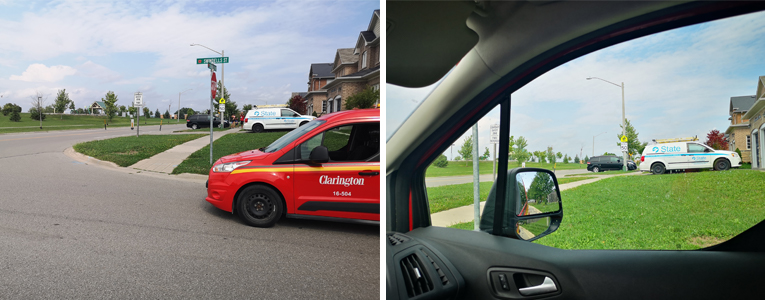
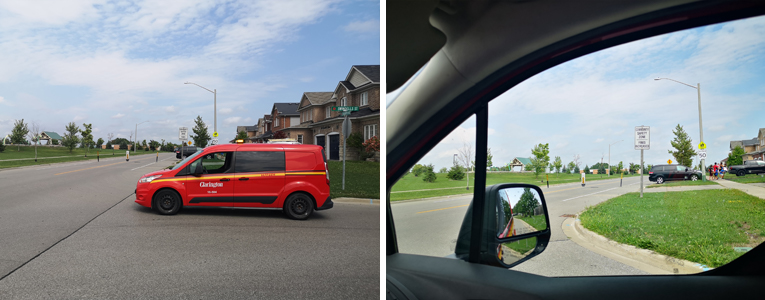
Occasionally, you may encounter situations where visibility is obstructed at a blind intersection. In this case, come to a complete stop at the blind intersection, then slowly ease forward past any obstructions to see if the intersection is clear so that you can proceed. This is known as the “creep and peep,” or “easing” method. Learn more about navigating blind intersections by reading the Ministry of Transportation Handbook.
Photos below: A partially obstructed view from the driver's perspective at a stop sign.
Photos below: The driver, after coming to a complete stop, has eased forward to the edge of the crossing lanes. From this position, sight lines have significantly improved, allowing the driver to safely and confidently proceed.
Frequently asked questions
What is the speed limit on my street?
How are different speed limits determined?
In determining the proper speed limit, a number of factors are considered, including the width of the road, traffic volumes, pedestrian activity, existing operating speeds, collision history, intersection spacing and the number of entranceways.
Speeds are established in the Highway Traffic Act and by local and Regional by-laws. An effective speed limit is reflective of both the existing operating speed and of driver expectations.
Can the speed limit be lowered?
Lowering the posted speed limit does not necessarily decrease the speed of vehicles, reduce collisions or improve safety. If the limit is unrealistically low, it creates a greater speed variance this is a factor in collisions as it tends to lead to more passing and unsafe manoeuvres. For example, some drivers may adhere to the speed limit while others drive at a speed they are comfortable with.
What should I do about the vehicles that speed on my street?
Residents concerned with excessive speed or dangerous driver behaviour are encouraged to participate in the Road Watch program found on the Durham Regional Police Service website. The Road Watch program gives residents an opportunity to participate in identifying and reporting dangerous and aggressive driving.
Another tool is the radar message board. It displays the actual speed of the passing car and makes the driver aware of their speed without the consequence of a fine. It also monitors and collects the speed data. To request a radar message board installation on your street, please submit your concern through the Service Clarington Portal.
Use our Traffic Information Map to see which streets have been monitored by a radar message board in the past few years.
For more information on speeding, see the Region of Durham's Road Safety page.
Traffic calming is a term most commonly associated with physical features placed on a roadway to influence the speed of vehicles.
Traffic calming measures such as speed humps can have a positive influence in reducing vehicle speeds. However, there are negative effects associated with traffic calming, including increased noise, increased air pollution, and diversion of traffic to adjoining streets. One of the most important factors is the support of the residents living on the street where traffic calming measures are being proposed.
Do traffic calming measures affect emergency response times?
Studies have shown that certain traffic calming measures, especially vertical measures such as speed humps and raised crosswalks, can slow fire trucks and other emergency vehicles by about eight to 10 seconds each.
Staff always inform residents requesting traffic calming measures of their impacts on emergency response times.
Do speed humps affect snow plowing?
Permanent speed humps and raised crosswalks are gradually sloped so that snow plow blades go over without damage to them or the pavement surface. However, drainage and storm sewer operation need to be considered at the very early stages of planning for a traffic calming device.
Do traffic calming measures affect property values?
There is no evidence to suggest that traffic calming measures either raise or lower residential property values.
How is the location for traffic calming measures determined?
Staff follow a standardized approach for assessing when and where traffic calming is needed. We evaluate factors such as:
- Traffic speed
- Volume of traffic
- Size of the road area
- Road classification
- Road design
- Transit impacts
These and other considerations help us determine whether traffic calming is appropriate and which measures will be most effective. The goal is to improve road safety while maintaining smooth traffic flow.
Contact Us
Address: 40 Temperance Street, Bowmanville, ON L1C 3A6
Phone: 905-623-3379
TTY: 1-844-790-1599


