Roundabouts

A roundabout is a one-way circular intersection designed to reduce congestion and maximize safety. There are several roundabouts in Clarington, including three multi-lane roundabouts at the Holt Road and Highway 401 interchange.

For those residents unfamiliar with the rules governing roundabout use, here's some useful information.

Tips for driving multi-lane roundabouts

  • Slow down and yield to vehicles in the roundabout
  • Watch for signs that help you decide what exit to take
  • Watch for signs and road markings that help you decide what lane to enter from
  • Watch for pedestrians in the crosswalk, and be prepared to stop
  • Give extra space for large trucks, they may need to use both lanes entering and circulating
  • Yield to traffic already in the roundabout that comes from your immediate left
  • Enter the roundabout when there is a gap in traffic
  • Do not enter and merge beside a vehicle or cyclist already circulating, even if it is travelling beside the central island
  • Travel counter-clockwise
  • Do not stop inside the roundabout. You have the right-of-way over entering traffic
  • If you are in the roundabout when an emergency vehicle approaches, exit as normal and proceed beyond the splitter island before pulling over
  • Maintain your lane position as you circulate
  • When approaching your intended exit, signal right and exit the roundabout
  • As you exit the roundabout watch for pedestrians in the crosswalk and be prepared to stop
  • Never make a left turn as you enter a roundabout

Always obey the signs and markings

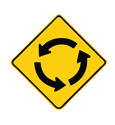
Roundabout ahead, time to slow down.
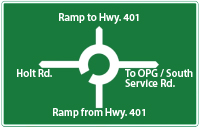
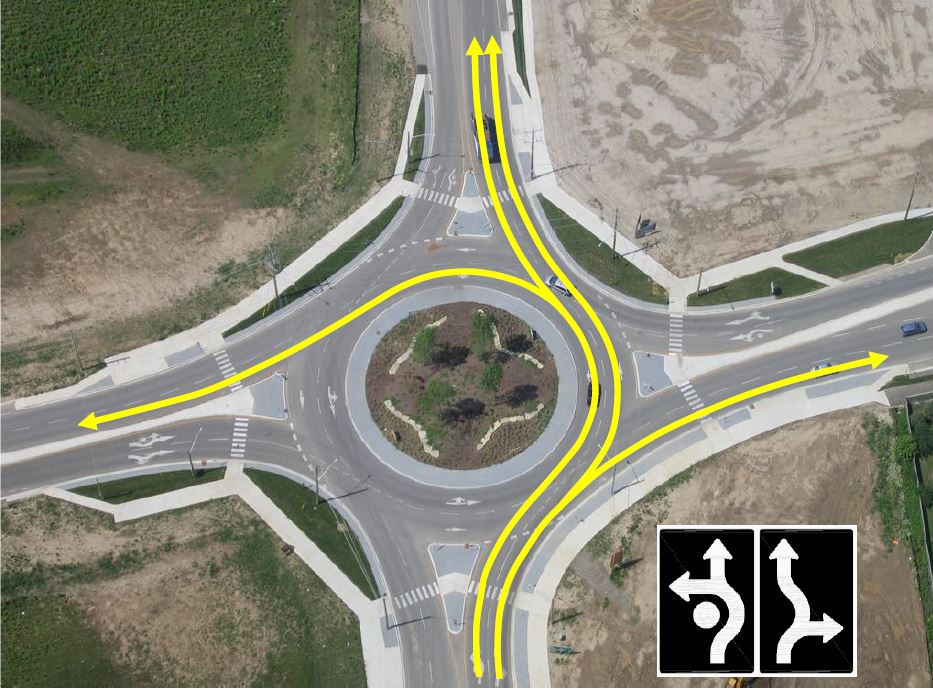
Guide signs near the entry show the correct exit to take.
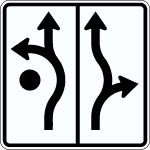
Choose the correct lane based on your exit, ensuring you make your way around the centre of the roundabout.
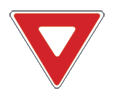
Yield to all traffic in the roundabout.
Roundabout traffic travels one-way.

Example of how to drive through a multi-lane roundabout

Frequently asked questions

Neither roundabouts nor four-way stop intersections have traffic lights.

The differences include: four-way stops yield to whoever arrives first, or the vehicle on the right, whereas roundabouts yield to the left because the circulating traffic comes from that direction.

At four-way stops, each direction gets a turn in order. At roundabouts, each driver chooses a safe gap to enter, and no driver "gets a turn."

Yes, modern roundabouts are designed to accommodate large vehicles such as farm equipment and truck transportation, but remember these types of vehicles have a larger turning radius than cars. Whenever possible, allow these large vehicles to enter the roundabout ahead of you and ensure they have clearance to occupy both lanes if necessary in order to manoeuvre around the roundabout.

Yes, snow removal at roundabouts will be similar to snow removal at other intersections throughout Clarington.

Pedestrians have the right of way. Be sure to slow down and yield to pedestrians. If you need to stop, never block the crosswalk and allow pedestrians to walk across completely before proceeding.

Some cyclists may choose to operate using the same principles as a vehicle within a roundabout, so please treat them with caution as you would any other vehicle. Yield to them as they travel in a counterclockwise fashion.

Other cyclists may choose to walk their bicycles through a roundabout crossover similar to pedestrians. In this case, please treat them as you would a pedestrian, giving them the right of way at crossovers.

Just continue around to your desired exit.

You need to signal the direction in which you are going to take, for instance:

Turning right

  1. Signal right as you approach the roundabout in the right-hand lane.
  2. Maintain your signal through the roundabout and stay in the right-hand lane.
  3. Maintain your signal as you exit in the right-hand lane.

Going straight

  1. Do not signal as you approach the roundabout and select the appropriate lane.
  2. Stay in this lane until you need to exit the roundabout.
  3. Signal right prior to your exit, and exit from the lane you are in.

Turning left

  1. Signal left as you approach the roundabout in the left-hand lane.
  2. Maintain your signal through the roundabout and stay in the left-hand lane.
  3. Signal right prior to your exit, and exit in the left-hand lane.

Going full circle (U-turn)

  1. Signal left as you approach the roundabout in the left-hand lane.
  2. Maintain your signal through the roundabout and stay in the left-hand lane.
  3. Signal right prior to your exit, and exit in the left-hand lane.

Experienced cyclists:

  • Ride as if you were driving a car.
  • Merge into the travel lane before the bike lane or shoulder ends.
  • Ride in the middle of your lane; do not hug the curb.

Use hand signals and signal as if you were a motorist:

Turning right

  • Signal right as you approach the roundabout.
  • Maintain your signal through the roundabout.
  • Maintain your signal as you exit.

Going straight

  • Do not signal as you approach the roundabout.
  • Signal right prior to your exit only.

Turning left

  • Signal Left as you approach the roundabout.
  • Maintain your signal through the roundabout.
  • Signal right prior to your exit.

Going full circle (U-turn)

  • Signal left as you approach the roundabout.
  • Maintain your signal through the roundabout.
  • Signal Right prior to your exit.
  • Watch out for drivers' blind spots.

For less confident cyclists:

  • Dismount and walk your bicycle.
  • Follow tips for pedestrians:
    • Step to the curb and point your finger across.
    • Look and listen for a safe gap in traffic flow.
    • Do not cross until the driver stops.
    • Keep and make eye contact with drivers in all lanes.
    • Do not cross the middle of the roundabout.
    • Wait on the splitter island.

The amount of traffic and appropriate travel speed generally determine the size of a roundabout. They are large enough for buses and large trucks, but small enough that you need to slow down to go around them.

Pull over as far to the right as possible and let the emergency vehicle pass as soon as possible. If feasible, completely clear the roundabout and pull off to the side.

  1. Entering collision, when a vehicle entering the roundabout does not yield to a vehicle already in the roundabout.
  2. Rear-end collision, usually at the entrance to the roundabout.
  3. A turning collision caused by drivers using the incorrect lane.  Example: Turning left from the right lane.

Contact Us

Address: 40 Temperance Street, Bowmanville, ON L1C 3A6

Phone: 905-623-3379
TTY: 1-844-790-1599